Showing posts with label Flanders. Show all posts

Wednesday, 16 April 2014

Bent Arrow: de Brabantse Pijl Challenge 2014

Saturday, April 12: the day before the Paris-Roubaix professional race amateurs had an opportunity to ride the storied cobbles themselves during the Paris-Roubaix Challenge Sportive.  But for those not willing to publicly display their pavé riding ineptitude, on the same day to the east another sportive mirroring a pro course provided an opportunity to publicly display one’s climbing ineptitude.  So of course I had to I had to do the two hour drive from Düsseldorf to Belgium to experience the 2014 Brabanste Pijl Wielertoeristen.


While not nearly as old as Paris-Roubaix, which dates back to 1896, de Brabantse Pijl (the Brabant Arrow), also known by its French name of La Flèche Brabançonne, has had many famous winners since its inaugural edition in 1961.  In fact the first winner, Belgian Pino Cerami (who is still with us at 91) won the 1960 edition of Paris-Roubaix and eventually went on to become the oldest winner of a Tour de France stage at 41 in 1963.  There is even a GP Pino Cerami held every year  since 1964 in Belgium; it was won by Alessandro Petacchi this year (also on April 12).  But the rolls of the Brabant Arrow offer many famous victors:  Tour de France winners Jan Janssen and Eddy Merckx;  Mr. Roubaix Roger de Vlaeminck; sprint legend Freddy Maertens; double Flanders winner Edwig Van Hooydonck (who won the Arrow four times); triple Flanders and triple Roubaix victor Johan Museeuw; triple World Road Champion Oscar Freire (three Arrow wins too), along with some guys named Boogerd, Chavanel, Bartoli and Sagan.  In 2011 Philippe Gilbert became the only rider to win all the Hilly Classics (Amstel  Gold, the Fleche Wallone, Liege-Bastogne-Liege) plus the Arrow in one year.  Categorized as a UCI 1.0 race since 2011, it is pretty important.  But I wasn’t riding that race but instead an event five days prior.

Proximus Cycling Challenges manages a series of 12 Belgian events for amateurs spread over eight months.  These “Wielerstochten” include versions of  the Scheldeprijs, the Omloop Het Nieuwsblad and Gent-Wevelgem, among others.  Entry is a reasonable 10 Euros, with feed stations included, route signage and, well, not much else.   There is the promise that some retired pros will show up and apparently on Saturday these included Johan Museeuw, Nick Nuyens, Ludo Dierckxsens and current cyclo-cross racer Niels Albert but they weren’t there when I arrived at 7:15 to sign in at the start in the old university town of Leuven, 25 kms east of Brussels.  In fact, most of the organizers had not shown up either as the ride was scheduled to start at 7:30 and there were no signs anywhere.   But cleverly obeying the Follow-Someone-Else-With-Bikes-on-the-Car-Roof Rule I soon enough found my way to the impressive Ladeuzeplein , Leuven’s major square which is overlooked by the huge old university library.

A moment to check in and given a wristband for the feed stations (no numbers or pins to mess with) and I was on my way through the streets of the city, founded in the 9th Century and featuring many beautiful 15th Century buildings typical of Flanders.  In fact, the city is the capital of Flemish Brabant, a region that came about in 1995 when the province of Brabant (which has a long and headache-inducingly  complex history) split into three parts: the Flemish one, the Walloon (French-speaking one) and the Brussels autonomous region.  The Arrow goes into both Flemish and Francophone areas.
There were not many riders at this time of morning as the start was open until 10 am and the majority of cyclists were probably doing the shorter 72 km route rather than the 131 kms I was aiming at.  It was easy to get out of Leuven, which only has a population of 100,000, and follow the purple arrow signs showing the way west towards Bertem.  The loop heads south and then east of Leuven before working its way back and while it covers sections the pro race will take the fast guys will head more southwest in a straight line—hence the “Arrow” name.

The organizers thoughtfully provide a list of the hills and feed stations that you can stick on your toptube, giving you a distance countdown from 131 kms.  The first few of the 16 indicated hills are not really noticeable until you get to Langestraat at 113 kms, which is still an easy 6% average for 600 m.  The weather was not very good as riding in dense fog I had to stop to wipe the condensation off of my glasses and there was a steady dripping of water from my helmet.  But traffic was light although I was passed from time to time by big groups of fast Belgian club riders who were clearly not planning to stop to take photos.

At Km 99 there was an interesting change in the fairly flat landscape as we turned a corner near Huldenberg and were suddenly confronted with Smeysberg, a startling climb that maxed out at 17 percent but luckily only went on for 600 m.  Looking around, I discovered that Belgians are not afraid of using enormous pie-plate-sized cassettes to deal with the poisonous little climbs of the region.  Soon after this we had the Ijskelderlaan, a more reasonable 12 percent maximum grade and the first Hellingen that we would see that would actually be on the pro course, marked with black and yellow arrows.  A few more turns through a residential area brought us to Overijse and the first feed station.


For your 10 Euros you have a pretty good selection of eats, including bananas, oranges, chocolate-coated cookies and, everyone’s favourite, waffles.  There was energy drink as well as a station with hoses and faucets where everyone could easily refill their bottles.  A mechanic was on duty and keeping busy and overall one could not help but be impressed by the organization of the whole thing.
Waffles!


The sun had burned off the fog an hour before and we headed off for the next segment, which seemd to be doing a lot of looping around Overijse to include climbs (Schavei, Hagaard, Heerstraat) on the pro route.  In spite of the dizzying parcours (Wait: is that Huldenberg yet again?) by the time we descended Heerstraat we were turned east towards Walloon Brabant, crossing into the French-speaking region at Km 65 and leaving the pro route behind for the remainder of the day. 

The course was definitely flatter now as we headed through the open fields or past orchards of apple trees in full blossom around Beauvechain, passing near a military airport.  There was only one climb on the list worthy of mention, the Rue de Pecrot which hit nearly 14 percent.  It average 6 percent but went on for a long time.  It was quite warm now and I took off my armwarmers and was comfortable riding in shorts and short sleeves.  Many of the locals were fully outfitted with tights and jackets but they also looked like their body fat percentage was modest compared to mine!

There was a wonderful moment when I turned a corner and stopped to take a photograph of the cobbled climb that had suddenly appeared.  I moved over to the wide and smooth sidewalk/bikepath and as I took out my camera large groups of riders also appeared.  Everyone’s response  to the unexpected challenge of the cobbled was the same and as each group came by the lead riders swore audibly in Flemish, apparently from an inexhaustible source of curse words that seems to be their linguistic heritage. 


I was starting to get a bit tired now from the climbing (to say nothing of my laughably insufficient training) and was relieved when the second feed station appeared at Willebringen.  Some more waffles and the home stretch began.  I mentally braced myself for the hill at Neeverlpsestraat at Km 29 but it was pretty easy.  What was tougher was the final climb at Km 8 on Korbeekdamstraat, another 500 m with a maximum of 11 percent, and where I was not the only cyclist to suffer from leg cramps.  But soon enough the road dropped and we found ourselves on a fast run-in to Leuven and the Ladeuzeplein.

Crossing the finish line resulted in nothing more than a good feeling. No photographers.  No podium girls.  No podium.  Unlike the Paris-Roubaix Challenge there are no medals or, well, anything except marquees where plenty of club riders were already putting down plenty of beer.  Leuven, in addition to its ancient Catholic university, is also the home of Anheuser-Busch InBev, the world’s largest producer of beer.  Unlike German rides which often begin at sports grounds there were also no showers but it was a short drive for me to Kortrijk and my hotel.  The next day I would watch the Paris-Roubaix pro race with my own beer in hand from the comfort of a luxury tour bus but my experience at Brabantse Pijl, riding with 2400 others in the phantom wheeltracks of Eddy Merckx and the rest, just confirmed that Belgium remains one of cycling’s Promised Lands.

For more information about other amateur events organized by Proximus Cycling Challenges, go to the not entirely comprehensible sort-of trilingual website here.


Friday, 14 February 2014

WieMu: The Belgian National Cycling Museum


Belgium is an unusual country, with a population split between two different languages and religions and essentially having two separate governments except on national issues such as defence. A history of stubbornness and argumentation make it the ideal capital of the European Union, with its 27 contentious Member States. But everyone is agreed about the great things in Belgium: beer, chocolate, beer, frites, beer and its status as a cycling mecca, famed for its brutal Spring Classics and cobbled roads and muddy cyclocross races. And of course it has to offer not one but two excellent cycling museums. I already reported on my visit to the Tour of Flanders Center in Oudenaarde but for a more general picture of cycling in the country we go elsewhere, to the West Flanders town of Roeselare.

In Flemish the name Wielermuseum is “Bicycle Museum” and it refers to itself as WieMu. Housed in an impressive 19th Century armoury, the museum aims to provide a history of the bicycle as well as giving focus to racing, primarily on the road but also on the track and cross course. Entering through the arched doorway and after paying the reasonable admission price the visitor walks down a hallway with exhibits covering the very early history of the bicycle: there is a replica of Baron Drais' 1817 “Laufrad” as well as a very good replica of the Kirkpatrick Macmillan bicycle of 1839, allegedly the first to use pedals but the claim is now doubted by historians. Next up is a very fine Michaux velocipede from c. 1869.


From the crude beginnings of the bicycle we move now to the era of the high-wheeler and the museum gives visitors to sit on one and crank like mad, powering a camera so that they can see themselves. Of course the bicycles is firmly supported so no risk of falling on your head, unlike the brave velonauts of old.


There are work bicycles and military bicycles with guns and prim ladies' specials, all pre-dating the Great War. Next is a very interesting display that is actually a bike workshop that was relocated from the village of Heule, where it was opened by Maurice Hallaert in the 1930s. In 1946 the owner expanded operations to include bicycle saddle production in addition to bike repairs and sales. Joining his father in 1952, Marcel Hallaert oversaw further expansion, leading to handbuilt frame production under the Fietsen Hallaert tradename until 1969. In 1989 Marcel Hallaert donated the workshop to WieMu and one can see how self-contained bicycle production was back in the old days.


With the exception of the workshop, most of what is on display at the museum up to this point really does not have much to do with Belgium, a country that did not actually see any of its own bicycle production until the rather late date of 1891, when the Derby brand (yes, an English name for cachet) was introduced. But now comes the heart of the museum and probably the most interesting part: racing history.


The museum has an excellent collection of classic racing bicycles but really is strongest in post-World War II items. Of note is the red Flandria that Rik van Looy (“the Emperor of Herentals”) used to win the 1962 Paris-Roubaix race, one of the many highlights in a 17 year career that saw him become the first man to win all five “Monuments,” a feat since only accomplished by two other riders (both Belgian, of course).


Certainly the Belgians have produced many legendary cyclists and the museum devotes some space to a number of them, including Eddy Merckx (who does not get as much as space as one would imagine, given his palmares) and the more recent Johan Museeuw, Tom Boonen and Philippe Gilbert. There is a comprehensive collection of jerseys of long-forgotten-except-by-fans teams.


A sobering moment comes when the visitor reaches the entire display room devoted to the life and career of J ean-Pierre Monseré, nicknamed “Jempi.” A son of Roeselare, he turned professional in 1969, winning the Tour of Lombardy for Flandria the same year. In 1970 he became World Champion in Leicester, the second-youngest to do so at the time, and also won a national title on the track. His 1971 year began well with victory at the Vuelta a Andalucia but while competing in a local Belgium race he struck a car that had entered the course and died of his injuries. He was 22 years old and his medals, jerseys and the Lombardy bike are all on display at the museum. A memorial race in his name continues to be held every September.


The visitor next walks by a case of Tom Boonen memorabilia and can stand next to Philippe Gilbert's Canyon Speedmax time trial bike, displayed with team and Belgian champion tricolour jersey. Then there is a break from all this road racing history with a too-small display area devoted to track racing, including a stayer motorcycle, a derny pacesetting machine and some posters from Six Day Racing. Of particular note is a display case with souvenirs of the 1964 Tokyo Olympics, including a fine portrait of Patrick Sercu who won gold in the 1000 m time trial and went on to become the greatest Six Day racer of the modern era with 88 wins.

Nick lusting for the Speedmax


A tip of the hat is given to cyclocross, but not much more which is surprising in light of the great success of Belgian riders and its extreme popularity in the country. But perhaps there will be exhibits in the future. A quick peek into the museum's attic will convince anyone that what is on display is only the tip of the iceberg when it comes to WieMu's holdings (which include a box of Paris-Roubaix cobblestones!).


Of course the real tourist can enjoy getting photographed with a cutout to make himself look like Eddy Merckx or Freddy Maertens and there is a nicely-stocked store featuring historic replica jerseys, books and even, yes, beer. Who could resist a six-pack of Malteni beer, labelled in those familiar Merckx colours?


The Belgians have a great history in cycling and the WieMu,which offers changing exhibits, should be on the must-see list for a cycling fans. Unlike the other Flemish museum, the signs are in three languages so no dictionary is needed to enjoy it all. And even though cycling is a Big Deal in the country, they don't always take it so seriously either.


WielermuseumPolenplein 15
8800 Roeselare
Belgium 
Telephone:051 26 87 40
e-mail: wielermuseum@roeselare.be
Website: http://www.wielermuseum.be/en/home/ Note: a good part of this in English but at some point they just gave up translating so be prepared to switch to Flemish or French!
Opening Hours: Tuesday to Saturday, 10 am to 5 pm

Saturday, 28 December 2013

All Hail De Ronde! The Centrum Ronde van Vlaanderen

The Royal Tyrell Museum in Drumheller, Alberta is the only palaeontological museum in the world where you can walk outside and actually dig up dinosaurs. Bicycle racing has its equivalent: in Oudenaarde, Belgium where the excellent Tour of Flanders Centre, housed in a modern building, stands near to the finish line of arguably the greatest One Day Classic: the Tour of Flanders. And you can go off and ride the Tour yourself from the front door. But you had better enjoy cobblestones.


My enjoyable interlude in Oudenaarde in May to participate in the excellent Retro Ronde offered so many activities it limited time available to see the Centrum so a return trip was in order. The plan this time was to bring a modern bicycle and ride some of the hellish Hellingen, the horrible short climbs, often on cobbles, that are to be found in the region and make up an integral part of the Tour of Flanders and then to check out the museum and then drink beer.


The Centrum Ronde van Vlaanderen offers one-stop shopping: in addition to the museum and popular cafe it offers GPS-linked routes from the museum out into the Flemish countryside and in a fit of derring-do we decided to go for the Blue Route, the shortest but hilliest of the three suggestions.


Parking near the museum on a sunny Sunday morning in September and assembling the bicycle, it was amazing to see how many cyclists were already on the road, most in large groups. The Flemish are very well-organized when it comes to cycling clubs and you will see very sizable numbers of riders, often with an accompanying vehicle, enjoying the rolling countryside. Well, it actually isn't so much rolling as pretty flat except for a ridge that is an extension of the Ardennes and that you continually cross from different angles.


The Garmin directed me around the town a bit until we finally picked up a Blue Route sign and began the ride in earnest. It was a glorious day and the first stretch of riding took us along the banks of the Schelde, which had a bit of barge traffic, and it was a good opportunity for some leg-stretching before the challenges ahead. On the other side of the river stands Petegem-aan-de-Schelde, another reminder of a champion cyclist since the similarly-named Peter van Petegem is also from hereabouts. At Km 8.2 the course turned left and soon we were climbing the Oude Kwaremont, which was also featured on the Retro Ronde but had not gotten any easier four months later. Luckily there was no traffic except for a young man on his shopping bicycle who effortlessly passed me as I negotiated the cobbles.


Oude Kwaremont behind me, I found myself on a main N36 road with a huge group of club cyclists but left them on the broad climb when one of them flatted and everyone else waited. Another turn to the left and ahead was the Rampe but I was disappointed (well, relieved) that it was a gradual descent on good pavement rather than the hellish climb of the same name I had experience in May. But then a sharp turn to the right at Km 15 suddenly brought harsh reality: the Paterberg.


This is an awful climb and is now used multiple times during the Tour of Flanders, being more recently used by Fabian Cancellara as his springboard to win the 2013 Tour. It is only 380 m long but averages nearly 14 percent, with a maximum of 20 percent. In 2000 this was one of three climbs I was forced to walk up during the sportif version of the Tour and history repeated itself. I was passed by a number of the club riders but noticed more than a few were joining me on foot lower down the hill.


This humiliation behind, it was time to roll further onwards on the Blue Route. At Km 21 there was a sign for the Koppenberg but I had to wait for a while as a parade of ancient but impeccably maintained antique farm tractors rolled by. Then it was time to head up the Koppenberg. Well, after a while it was time to walk up the Koppenberg. This ridiculous piece of cobbled vertical road was introduced to the Ronde in 1976 but was dropped in 1987 as it was deemed to dangerous for cyclists. It is 620 m in length and the maximum grade is 22 percent. It is very tricky to pick your way through the cobbles with so little momentum and I was joined again by a number of club riders, all of whom seemed very experienced at pushing their bikes. At least there was a pleasant view of the plain below.


Descending and then crossing the N60 I soon found myself on a gentle climb on a wide but wretchedly-cobbled road, the Mariaboorestraat. This led to a short climb, the Stationsberg, at Km 28. Things were going better now as I gingerly proceeded but as a began the gentle descent toward the railway crossing there was a loud “Ping!” as a rear spoke snapped, victim of the merciless pavé. My low-spoke-count wheels meant I now had an unrideable bicycle. I would have been better off with my c. 1978 Cicli Diamant with its thick seatstays and 36-spoke wheels.

Crossing the tracks and getting my bearings, I met a local at the recycling depot. He had a small SUV and I prevailed upon him to give me a ride back to Oudenaarde, which turned out to be only six kilometers away. My 78 km ride had turned into less than 30 km but these things happen. I put the bicycle in the car and walked over to the museum.

The museum is really one-stop shopping. Walking in with my cycling gear and my kit bag, I asked to use the showers and was directed down the hall. After a refreshing wash-up and change of clothes, I returned to the front desk to pay and handed my 2.50 Euros for the shower to none other than Freddy Maertens, two-time Road World Champion, Vuelta winner and the finest sprinter of his day. He was joined at the cash register by a very attractive blonde Belgian who has since gained Pezcyclingnews immortality as a Daily Distraction.


When I asked if I could have a picture with Mr. Maertens there was a horrified response from both of them. I may be the only person in the last few decades who has called him “Mr.” so “Freddy” it is. And he was very gracious about the photo. Freddy Maertens is very personable and speaks excellent English so we had a nice chat about current sprinters, discussing the styles of Marcel Kittel and Mark Cavendish. He had a very rough patch after his cycling career ended but now serves as the curator of the museum and three times a week offers tours. Although he never won the Ronde, with his best performance being a second place in 1973, he boasts a remarkable palmarès, including the aforementioned dual World Championship titles but also 16 stage wins at the Tour de France, where he won the Green Jersey three times, and the crazy 1977 Vuelta, where he sprinted to victory in 13 stages! He also took seven stages at the Giro that year.

Freddy Maertens on the Koppenberg, also pushing
 

The Centrum was renovated in 2012 and looking past the big picture window in the lobby you will see a replica of the Volvo team car used by Molteni in Eddy Merckx's glory days. Before entering the museum you will walk by a bicycle covered with Swaroski crystal and the more practical Ridley time trial bicycle ridden by Tour de France victor and World Champion Cadel Evans. 


Leaving Freddy to attend to his other duties, you will enter a museum which is dedicated solely to the Tour of Flanders. Freddy recommended the short introductory video with fancy split-screen effects, showing highlights of the race over the years. It was a quiet day; I made up half of the audience.


The Ronde van Vlaanderen began in 1913, the brainchild, like the Tour de France and the Giro d'Italia, of a journalist. He was Karel Van Wijnendaele and in Belgium, dominated by French-speaking Wallonia, he felt that there should be an outlet for the aspirations of the Dutch-speaking Flemish. Incidentally, there are no English legends on any of the exhibits at the museum but it is pretty easy to understand what it is all about.


The exhibits trace the origins of the race and its many highlights. The 2013 race was the 93rd edition so there is a lot of ground to cover. French and Italian racers went to Milan-San Remo, which was scheduled on the same day as the Ronde in its early years, so between 1913 and 1948 only one non-Belgian (a Swiss) won. Belgians have won no less than 68 times (the Italians are next at 10) and of those wins only one was by a Walloon, Claude Criquielion in 1987.


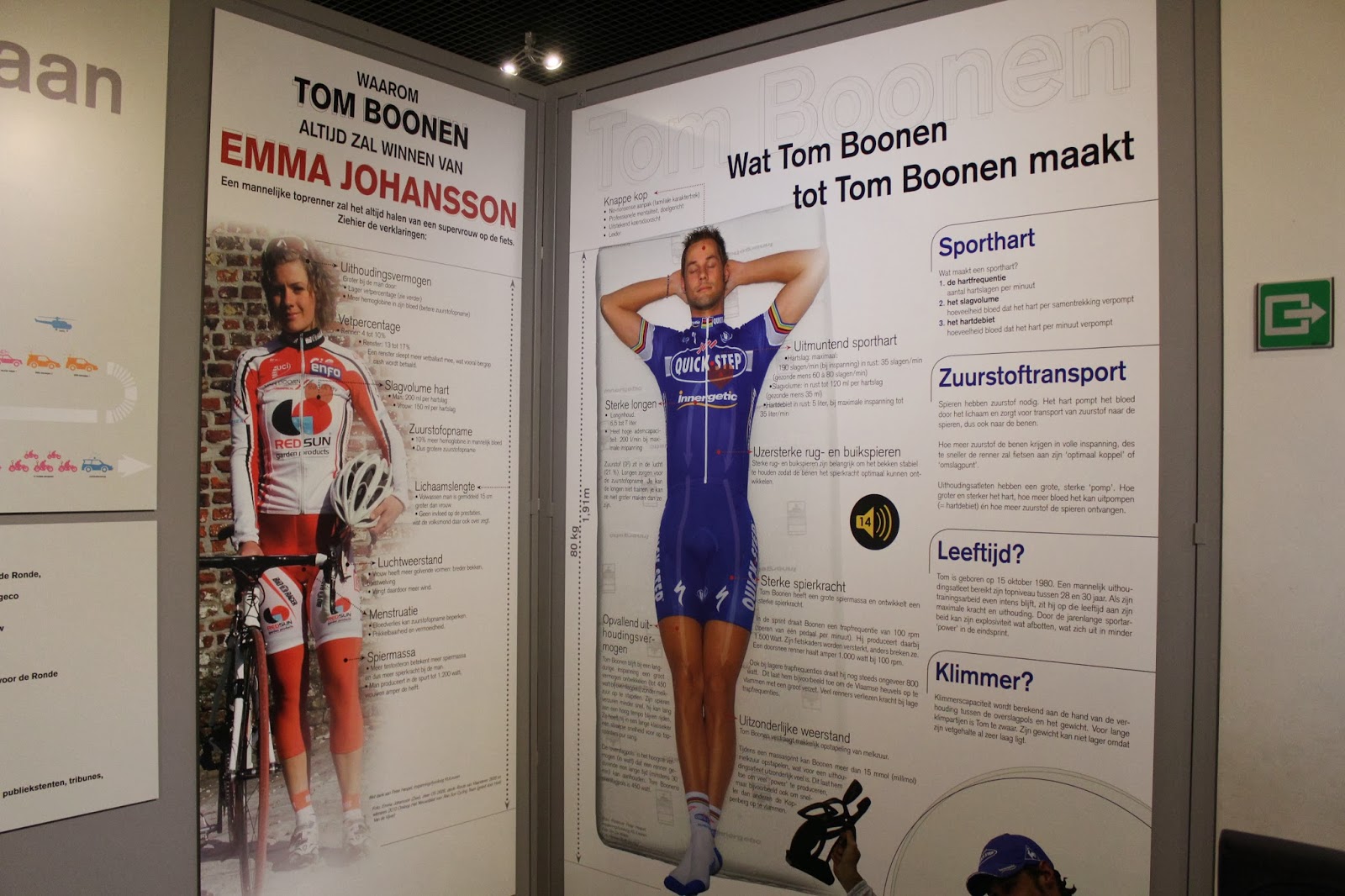
The museum is certainly dedicated to Flemish pride (don't look for French-language labels either) and there are some wonderful exhibits, including one entitled “What is a Flandrian?” and is captioned: “They are carved from the same rock from which statues are sculpted.” Tough is good. Feminists will have a laugh about the exhibit explaining why Tom Boonen is much, much stronger than Emma Johannson. I did not notice any special exhibit dedicated to the Women's Tour of Flanders, which is a shortened version of the men's race and is held the same day.


Enough quibbling: there is plenty of good stuff to see here. There are exhibits of many Holy Objects, such as the bicycle Johan Museeuw rode at the Ronde in 1998 and lots of jerseys and many old bicycles. In addition to Ridley, Flanders has had other notable bicycle brands, such as Groene Leowe (“Green Lion”) but clearly the most-loved was ill-fated Flandria, whose red bicycles were a symbol of Belgian dominance in pro racing. The company was founded in the 1950s and sponsored a pro team in the 1960s and 1970s which went on to win every significant race except the Tour de France (although Dutchman Joop Zootemelk came second twice on a Flandria there. The team roster was a Who's Who of cycling and the collapse of the company in 1981 when its moped business bankrupted Flandria came as a huge shock in the cycling world.


There is a special exhibition area dedicated to Walter Goodefroot, famous to a later generation as the directeur sportif of Team Telekom, but someone who had an impressive record as a pro racer himself. His wins included Liège-Bastogne-Liège three times, the Ronde twice and Paris-Roubaix in 1969. His three disqualifications for doping are not mentioned; in fact, doping does not exist in the happy world that is history in the Centrum van Vlaanderen. It is a Flemish celebration, after all, and there are better fora to discuss this problem.


The museum does celebrate its most recent edition with a display on the 2013 race and Fabian Cancellara, in spite of his sporting rivalry with Flemish demi-god Tom Boonen, was a popular winner and there is even a fan club for him in Belgium.


Exiting the museum brings you to a very good little shop where you can purchase retro-jerseys, books and DVDs, along with some excellent Lion of Flanders memorabilia. And after all this cobblestoned excitement, what better time than to walk over to the always-busy brasserie “de Flandrien” for some excellent Belgian beer brewed especially for the place, which also serves as the clubhouse for a local cycling club.

The Centrum Ronde van Vlaanderen is a commendable effort that brings together local pride, sporting tradition and community activity in one very pro-cycling environment. Located 30 kms south of Ghent and 75 kms west of Brussels it should be on the itinerary of every cycling enthusiast. Just be sure to bring a strong wheelset.

Information about the Centrum van Vlaanderen can be found hereIt is open daily except Monday from 10:00 am to 6:00 pm, but is closed for most of January each year so check ahead. If you would like to ride in Flanders from the Centrum, three routes from 78 to 114 km are set out here.