The Royal Tyrell Museum in Drumheller,
Alberta is the only palaeontological museum in the world where you
can walk outside and actually dig up dinosaurs. Bicycle racing has
its equivalent: in Oudenaarde, Belgium where the excellent Tour of
Flanders Centre, housed in a modern building, stands near to the
finish line of arguably the greatest One Day Classic: the Tour of
Flanders. And you can go off and ride the Tour yourself from the
front door. But you had better enjoy cobblestones.

My enjoyable interlude in Oudenaarde
in May to participate in the excellent Retro Ronde offered so many
activities it limited time available to see the Centrum so a return
trip was in order. The plan this time was to bring a modern bicycle
and ride some of the hellish Hellingen, the horrible short climbs,
often on cobbles, that are to be found in the region and make up an
integral part of the Tour of Flanders and then to check out the
museum and then drink beer.

The Centrum Ronde van Vlaanderen offers
one-stop shopping: in addition to the museum and popular cafe it
offers GPS-linked routes from the museum out into the Flemish
countryside and in a fit of derring-do we decided to go for the Blue
Route, the shortest but hilliest of the three suggestions.

Parking near the museum on a sunny
Sunday morning in September and assembling the bicycle, it was
amazing to see how many cyclists were already on the road, most in
large groups. The Flemish are very well-organized when it comes to
cycling clubs and you will see very sizable numbers of riders, often
with an accompanying vehicle, enjoying the rolling countryside.
Well, it actually isn't so much rolling as pretty flat except for a
ridge that is an extension of the Ardennes and that you continually
cross from different angles.

The Garmin directed me around the town
a bit until we finally picked up a Blue Route sign and began the ride
in earnest. It was a glorious day and the first stretch of riding
took us along the banks of the Schelde, which had a bit of barge
traffic, and it was a good opportunity for some leg-stretching before
the challenges ahead. On the other side of the river stands
Petegem-aan-de-Schelde, another reminder of a champion cyclist since
the similarly-named Peter van Petegem is also from hereabouts. At Km
8.2 the course turned left and soon we were climbing the Oude
Kwaremont, which was also featured on the Retro Ronde but had not
gotten any easier four months later. Luckily there was no traffic
except for a young man on his shopping bicycle who effortlessly
passed me as I negotiated the cobbles.


Oude Kwaremont behind me, I found
myself on a main N36 road with a huge group of club cyclists but left
them on the broad climb when one of them flatted and everyone else
waited. Another turn to the left and ahead was the Rampe but I was
disappointed (well, relieved) that it was a gradual descent on good
pavement rather than the hellish climb of the same name I had
experience in May. But then a sharp turn to the right at Km 15
suddenly brought harsh reality: the Paterberg.

This is an awful climb and is now used
multiple times during the Tour of Flanders, being more recently used
by Fabian Cancellara as his springboard to win the 2013 Tour. It is
only 380 m long but averages nearly 14 percent, with a maximum of 20
percent. In 2000 this was one of three climbs I was forced to walk
up during the sportif version of the Tour and history repeated
itself. I was passed by a number of the club riders but noticed more
than a few were joining me on foot lower down the hill.


This humiliation behind, it was time to
roll further onwards on the Blue Route. At Km 21 there was a sign
for the Koppenberg but I had to wait for a while as a parade of
ancient but impeccably maintained antique farm tractors rolled by.
Then it was time to head up the Koppenberg. Well, after a while it
was time to walk up the Koppenberg. This ridiculous piece of cobbled
vertical road was introduced to the Ronde in 1976 but was dropped in
1987 as it was deemed to dangerous for cyclists. It is 620 m in
length and the maximum grade is 22 percent. It is very tricky to
pick your way through the cobbles with so little momentum and I was
joined again by a number of club riders, all of whom seemed very
experienced at pushing their bikes. At least there was a pleasant
view of the plain below.


Descending and then crossing the N60 I
soon found myself on a gentle climb on a wide but wretchedly-cobbled
road, the Mariaboorestraat. This led to a short climb, the
Stationsberg, at Km 28. Things were going better now as I gingerly
proceeded but as a began the gentle descent toward the railway
crossing there was a loud “Ping!” as a rear spoke snapped, victim
of the merciless pavé. My
low-spoke-count wheels meant I now had an unrideable bicycle.
I would have been better off with my c. 1978 Cicli Diamant with its
thick seatstays and 36-spoke wheels.
Crossing the tracks and getting my
bearings, I met a local at the recycling depot. He had a small SUV
and I prevailed upon him to give me a ride back to Oudenaarde, which
turned out to be only six kilometers away. My 78 km ride had turned
into less than 30 km but these things happen. I put the bicycle in
the car and walked over to the museum.
The museum is really one-stop shopping.
Walking in with my cycling gear and my kit bag, I asked to use the
showers and was directed down the hall. After a refreshing wash-up
and change of clothes, I returned to the front desk to pay and handed
my 2.50 Euros for the shower to none other than Freddy Maertens,
two-time Road World Champion, Vuelta winner and the finest sprinter
of his day. He was joined at the cash register by a very attractive
blonde Belgian who has since gained Pezcyclingnews immortality as a Daily
Distraction.

When I asked if I could have a picture
with Mr. Maertens there was a horrified response from both of them.
I may be the only person in the last few decades who has called him
“Mr.” so “Freddy” it is. And he was very gracious about the
photo. Freddy Maertens is very personable and speaks excellent
English so we had a nice chat about current sprinters, discussing the
styles of Marcel Kittel and Mark Cavendish. He had a very rough
patch after his cycling career ended but now serves as the curator of
the museum and three times a week offers tours. Although he never
won the Ronde, with his best performance being a second place in
1973, he boasts a remarkable palmarès,
including the aforementioned dual World Championship titles but also
16 stage wins at the Tour de France, where he won the Green Jersey
three times, and the crazy 1977 Vuelta, where he sprinted to victory
in 13 stages! He also took seven stages at the Giro that year.
 |
| Freddy Maertens on the Koppenberg, also pushing |

The Centrum was renovated in 2012 and
looking past the big picture window in the lobby you will see a
replica of the Volvo team car used by Molteni in Eddy Merckx's glory
days. Before entering the museum you will walk by a bicycle covered
with Swaroski crystal and the more practical Ridley time trial
bicycle ridden by Tour de France victor and World Champion Cadel
Evans.

Leaving Freddy to attend to his other
duties, you will enter a museum which is dedicated solely to the Tour
of Flanders. Freddy recommended the short introductory video with
fancy split-screen effects, showing highlights of the race over the
years. It was a quiet day; I made up half of the audience.
The Ronde van Vlaanderen began in 1913,
the brainchild, like the Tour de France and the Giro d'Italia, of a
journalist. He was Karel Van Wijnendaele and in Belgium, dominated
by French-speaking Wallonia, he felt that there should be an outlet
for the aspirations of the Dutch-speaking Flemish. Incidentally,
there are no English legends on any of the exhibits at the museum but
it is pretty easy to understand what it is all about.

The exhibits trace the origins of the
race and its many highlights. The 2013 race was the 93rd
edition so there is a lot of ground to cover. French and Italian
racers went to Milan-San Remo, which was scheduled on the same day
as the Ronde in its early years, so between 1913 and 1948 only one
non-Belgian (a Swiss) won. Belgians have won no less than 68 times
(the Italians are next at 10) and of those wins only one was by a
Walloon, Claude Criquielion in 1987.

The museum is certainly dedicated to
Flemish pride (don't look for French-language labels either) and
there are some wonderful exhibits, including one entitled “What is
a Flandrian?” and is captioned: “They are carved from the same
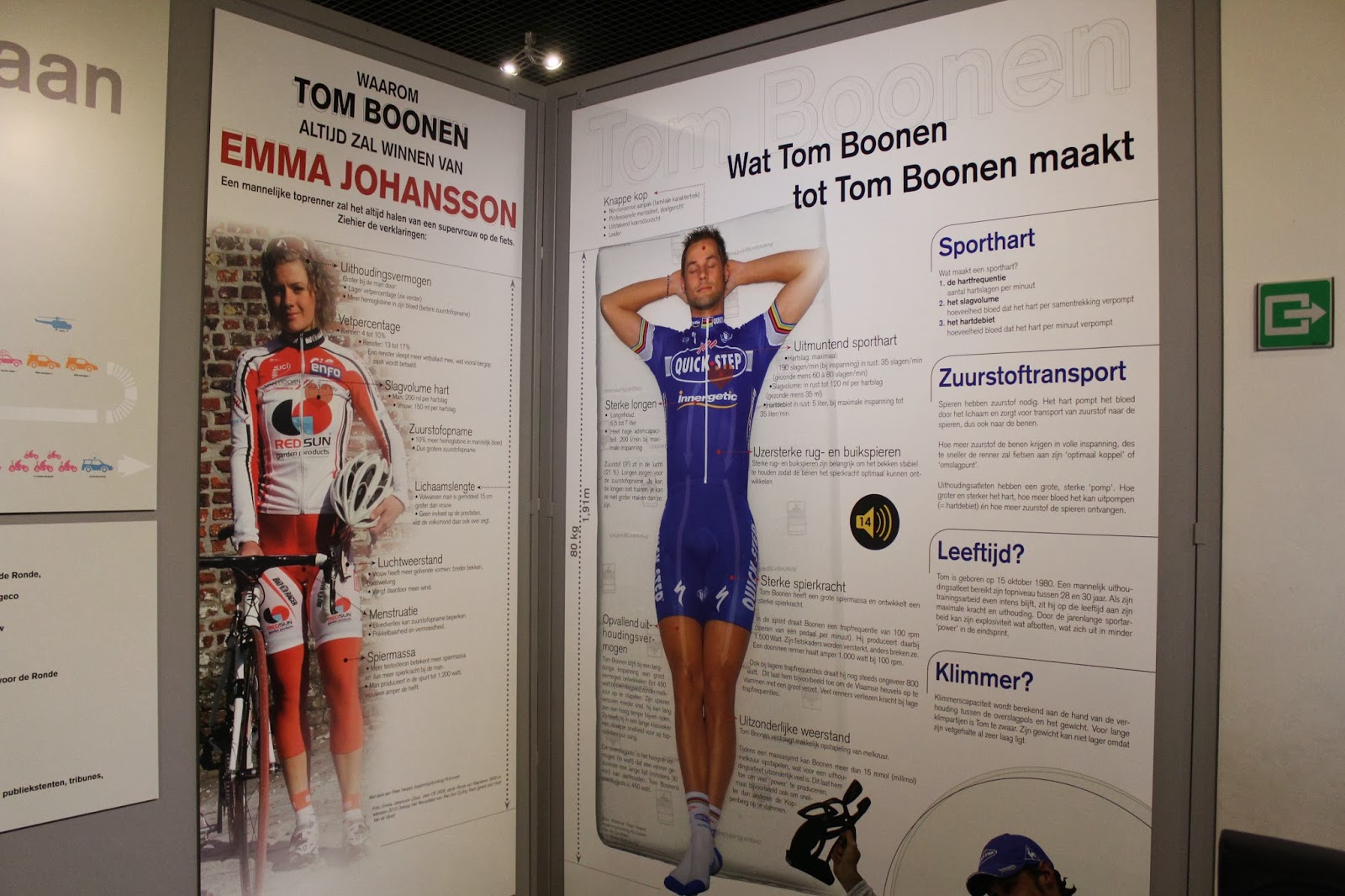
rock from which statues are sculpted.” Tough is good. Feminists
will have a laugh about the exhibit explaining why Tom Boonen is
much, much stronger than Emma Johannson. I did not notice any
special exhibit dedicated to the Women's Tour of Flanders, which is a
shortened version of the men's race and is held the same day.

Enough quibbling: there is plenty of
good stuff to see here. There are exhibits of many Holy Objects,
such as the bicycle Johan Museeuw rode at the Ronde in 1998 and lots
of jerseys and many old bicycles. In addition to Ridley, Flanders
has had other notable bicycle brands, such as Groene Leowe (“Green
Lion”) but clearly the most-loved was ill-fated Flandria, whose red
bicycles were a symbol of Belgian dominance in pro racing. The
company was founded in the 1950s and sponsored a pro team in the
1960s and 1970s which went on to win every significant race except
the Tour de France (although Dutchman Joop Zootemelk came second
twice on a Flandria there. The team roster was a Who's Who of
cycling and the collapse of the company in 1981 when its moped
business bankrupted Flandria came as a huge shock in the cycling
world.


There is a special exhibition area
dedicated to Walter Goodefroot, famous to a later generation as the
directeur sportif of Team Telekom, but someone who had an impressive
record as a pro racer himself. His wins included
Liège-Bastogne-Liège
three times, the Ronde twice and Paris-Roubaix
in 1969. His three disqualifications for doping are not mentioned;
in fact, doping does not exist in the happy world that is history in
the Centrum van Vlaanderen. It is a Flemish celebration, after all,
and there are better fora to discuss this problem.

The museum does celebrate its most
recent edition with a display on the 2013 race and Fabian Cancellara,
in spite of his sporting rivalry with Flemish demi-god Tom Boonen,
was a popular winner and there is even a fan club for him in Belgium.


Exiting the museum brings you to a very
good little shop where you can purchase retro-jerseys, books and
DVDs, along with some excellent Lion of Flanders memorabilia. And
after all this cobblestoned excitement, what better time than to walk
over to the always-busy brasserie “de Flandrien” for some
excellent Belgian beer brewed especially for the place, which also
serves as the clubhouse for a local cycling club.

The Centrum Ronde van Vlaanderen is a
commendable effort that brings together local pride, sporting
tradition and community activity in one very pro-cycling environment.
Located 30 kms south of Ghent and 75 kms west of Brussels it should
be on the itinerary of every cycling enthusiast. Just be sure to
bring a strong wheelset.


