Showing posts with label cobblestones. Show all posts

Wednesday, 24 December 2014

Book Review: Roads Were Not Built For Cars


The usual books stacked next to my comfortable wingback chair in the oak-panelled library for review lean towards accounts of great races, great (and sometimes not-great-at-all) athletes, startling training methods, startling diets, irresistible tourism ideas and lots of road-going technology, both old and new. But occasionally a book comes to us that does not fit into any of these categories and not only informs us of previously-unknown facts but might have an importance extending beyond cycling enthusiasts. One of these books has to be “Roads Were Not Built for Cars” by Carlton Reid, an exceptionally well-researched book whose very title is fightin' words. This might be ammunition against those motorists (we have all experienced them) who loudly proclaim that cyclists have no right to use public roads but the author unrolls a fascinating story whose details occasionally surface but the greater history has certainly been lost, or buried.


In 2013 Mr. Reid put out an appeal on a crowdfunding site and obtained pledges from 648 people, enough to conclude his massive four year research effort with a book that totals 170,000 words and in electronic format includes 580 illustrations and more than 10 videos. Yes, an electronic version: the book was conceived for iPad iBooks and is available in that way as well as via Kindle and an ePub version. A softback version was sent to subscribers and a hardback edition sold out in six hours. A revised edition will be published in 2015. So the most modern technology (crowdfunding, e-publishing) has been used to present a story that covers the period from the high-wheeler era and the start of the safety bicycle to the fading of the two wheeler from the consciousness of the motorcar-obsessed world. We find ourselves perhaps on the leading edge of a great new bicycle revival but Mr. Reid's book informs us of an unknown world that existed only less than 150 years ago and shows how our current world could have been much different.

A predecessor of Mr. Reid, Karl Kron, published a book in 1887 entitled “Ten Thousand Miles on a Bicycle” which was also crowdfunded by subscribers. Although Mr. Kron's massive 800 page book may be one of the dullest creations ever put to paper, one cannot but approve of the quote from that book that Mr. Reid uses to introduce his own work:

“The bicycle is an index to the existence of good roads, just as certainly as the good roads themselves are an index to the existence of a high degree of civilization in the locality possessing them.”

The theme of this important book is the history of roads and in particular the importance of cyclists in developing the excellent roads we take for granted today. The author, who is British, focuses primarily on the UK and US experiences centred on the 1880-1900 period but also provides a good account of the history of roads before then, from the construction of the straight Roman streets to the turnpikes of the 18th Century. But the first surprise he reveals is that by the time bicycles had appeared on the scene in a significant way roads, once used by horse-drawn stagecoaches and mail express wagons, had been rendered obsolete by the railway and grass now grew on once-busy thoroughfares. It would have amazed contemporary observers that the mighty railroads would be supplanted by road vehicles but, as the author reminds us, the Age of Motorcars may be just as doomed to end due to overcrowding, construction costs and environmental effects and what we see is irreplaceable may not be so.


The first cyclists were wealthy, able to afford their expensive machines, and wealth means influence. Many of the early cyclists were professionals and the ranks of Parliament including more than a few, both in the Commons and the House of Lords. They demanded smooth, dust-free roads and passed legislation that reorganized jurisidiction over roads, once seen as completely local, and mandated their maintenance. Serious lobbying occurred on both sides of the Atlantic and very considerable success was achieved.

New technologies arrived to make the construction of these new roads possible and we are given an overview of them, from asphalt to macadam to, surprisingly, wood. One thinks of cities like London offering primarily cobbled streets (“setts” rather than “cobbles, technically) but in fact many of the city's thoroughfares were made up of hardwood blocks which may have been smooth to travel over but in the Age of Horses not very sanitary at all and probably not that durable under iron-shod wheels.

Although the proponents of Good Roads were at pains to indicate that the roads would benefit everyone from city-dwellers wanting to travel to farmers moving produce, there was certainly a degree of self-interest. One of the primary sponsors of the movement in the United States, the colourful Colonel Albert Pope, was the head of the Columbia Bicycle Company, one of the largest such enterprises. However, the efforts by the League of American Wheelmen in the United States and the Cyclists' Touring Club in the UK showed what determined teamwork could produce. For example, the city of Hagerstown, Maryland (not Pennsylvania, as indicated in the book) offered roads, in 1889, of “a very superior quality:”

...eight superb limestone pikes radiate from Hagerstown...while intersecting pikes and cross roads form a network of thoroughfares for wheelmen that realizes the stereotyped phrase of cyclers' paradise. These pikes are of that smooth sand-papered kind that entrance the wheelman, while his surroundings of scenery and sweet odours from nature's garden make his runs veritable trips through fairy land...

In addition, the asphalted streets of Washington, DC, were seen as worthy of emulation elsewhere. There were wonderful projects planned, including an elevated bicycle highway in California.


But this remarkable state of affairs had a dark cloud on the horizon. The groundbreaking work (in every sense) of the road lobbyists of the LAW and CTC was soon to be overtaken by a new user of the road. The motorcar, which was not distinguished by sweet odours from nature's garden but was rather characterized as a murderous “stinkwagon” arrived noisily on the scene—driven for the most part by those same people who had been early adaptors of the bicycle! There was a great ruckus and attempts to ban cars. The author details how the lawful rights to road usage were once determined but arrogant motorists simply forced other users off of the roads as might became right.

Leading the group is C.S. Rolls, of Rolls-Royce note, who moved from bicycles to fast cars and utimately, but fatally, to aircraft, perishing in the crash of his Wright Flyer in 1910
Where once pedestrians, cyclists, streetcars and other modes of transport flourished, all fell before the onslaught of the mighty car. And now we come to the interesting idea behind the book: all the efforts of cyclists, those two decades of raising money, printing pamphlets, lobbying legislators and even building demonstration road sections, to ensure the acceptance of good roads, roads that were invaluable to all settlements they passed through for the common good, have not only been forgotten but history has been rewritten. For example, the author cites the self-congratulation of the Ford Motor Company in 1927 when, marking the building of the 15 millionth Model T, it claimed that the Ford car “started the movement for good roads.” This claim was to be repeated across the country. It was ironic in that Henry Ford's first car, the Quadricycle, owed much more to the bicycle than the carriage, as was often the case with pioneer automobiles. Henry Ford had been a keen cyclist and as the author points out in a fascinating appendix to the book almost every major figure in the automotive business had some connection to bicycles. These included Henry Leland, who founded both Cadillac and Lincoln; Albert Champion of spark plug fame and winner of the 1899 Paris-Roubaix bike race; Louis Chevrolet; the Dodge brothers (who once had a bicycle business in Windsor, Ontario); the Opel brothers (whose father, Adam, refused to consider constructing “stinkwagons for the rich” and now has a car named in his honour); Peugeot; Pierce-Arrow; Rover; Rolls-Royce—the list is impressive.

Promotional image for the powerful League of American Wheelmen (L.A.W.)
Not only did the automakers take advantage of the roads that were the work of the cycling lobby, but they also were able to use many technologies that were first developed for the two-wheeler, including spoked wheels, pneumatic tires, ball bearings, differential gearing and chain drives. With the advent of trams and buses, and eventually motorcars, the decline in cycling became precipitous. In 1898 there were 103,293 members of LAW; within seven years that number had fallen to 2,874 even though cars were not yet widespread. But as the car ascended, the bicycle, once seen as the very symbol of modernity and progress, became a second-class citizen on the very roads it had once made possible. It is only in recent years that bicycles have regained some of that lost status and may play a more important role in our transportation (and fitness) future than anyone would have thought. Of course, there are countries such as Denmark and the Netherlands where the use of bicycles is already widespread but these other examples are beyond this book.

“Roads Were Not Built for Cars” is a fascinating book, describing the development of much of the world we see outside our doors if we live in an industrialized country. But it is also a warning about the dangers of twisting history, of forgetting why things are the way they are and in that respect provides much food for thought. Perhaps in a century people will be amazed at the idea that we once found 1.24 million annual deaths due to motorized traffic acceptable (war kills less than half a million), along with horrific air and noise pollution, the asphalting of our countryside, the need to support otherwise unpalatable dictatorships to ensure our fuel supply and the primary source of anthropogenic climate change in order to have two-and-a-half ton SUVs with one obese person in them sit in gridlocked traffic. As much amazed as they would be by the decline of passenger railroads or the disappearance of stagecoaches, perhaps.


“Roads Were Not Built for Cars,” which surely can be said to break new ground in cycling history, shows us not only the highway from the past but also how we might want to consider how we view the future. So the next time you are out cycling that smooth asphalt, think of how it came to be and salute those brave wheelmen, now forgotten, who made it once possible. But watch out for those cars.


“Roads Were Not Built for Cars” by Carlton Reid
580 pp., copiously illustrated

Available from Amazon.com in Kindle format for a mere US$ 8.74 but also available through iTunes as an iBook for US$25.99 with complete illustrations and notes. There seem to be all kinds of formats available, all at different prices, so for more information just go to: www.roadswerenotbuiltforcars.com

Saturday, 28 December 2013

All Hail De Ronde! The Centrum Ronde van Vlaanderen

The Royal Tyrell Museum in Drumheller, Alberta is the only palaeontological museum in the world where you can walk outside and actually dig up dinosaurs. Bicycle racing has its equivalent: in Oudenaarde, Belgium where the excellent Tour of Flanders Centre, housed in a modern building, stands near to the finish line of arguably the greatest One Day Classic: the Tour of Flanders. And you can go off and ride the Tour yourself from the front door. But you had better enjoy cobblestones.


My enjoyable interlude in Oudenaarde in May to participate in the excellent Retro Ronde offered so many activities it limited time available to see the Centrum so a return trip was in order. The plan this time was to bring a modern bicycle and ride some of the hellish Hellingen, the horrible short climbs, often on cobbles, that are to be found in the region and make up an integral part of the Tour of Flanders and then to check out the museum and then drink beer.


The Centrum Ronde van Vlaanderen offers one-stop shopping: in addition to the museum and popular cafe it offers GPS-linked routes from the museum out into the Flemish countryside and in a fit of derring-do we decided to go for the Blue Route, the shortest but hilliest of the three suggestions.


Parking near the museum on a sunny Sunday morning in September and assembling the bicycle, it was amazing to see how many cyclists were already on the road, most in large groups. The Flemish are very well-organized when it comes to cycling clubs and you will see very sizable numbers of riders, often with an accompanying vehicle, enjoying the rolling countryside. Well, it actually isn't so much rolling as pretty flat except for a ridge that is an extension of the Ardennes and that you continually cross from different angles.


The Garmin directed me around the town a bit until we finally picked up a Blue Route sign and began the ride in earnest. It was a glorious day and the first stretch of riding took us along the banks of the Schelde, which had a bit of barge traffic, and it was a good opportunity for some leg-stretching before the challenges ahead. On the other side of the river stands Petegem-aan-de-Schelde, another reminder of a champion cyclist since the similarly-named Peter van Petegem is also from hereabouts. At Km 8.2 the course turned left and soon we were climbing the Oude Kwaremont, which was also featured on the Retro Ronde but had not gotten any easier four months later. Luckily there was no traffic except for a young man on his shopping bicycle who effortlessly passed me as I negotiated the cobbles.


Oude Kwaremont behind me, I found myself on a main N36 road with a huge group of club cyclists but left them on the broad climb when one of them flatted and everyone else waited. Another turn to the left and ahead was the Rampe but I was disappointed (well, relieved) that it was a gradual descent on good pavement rather than the hellish climb of the same name I had experience in May. But then a sharp turn to the right at Km 15 suddenly brought harsh reality: the Paterberg.


This is an awful climb and is now used multiple times during the Tour of Flanders, being more recently used by Fabian Cancellara as his springboard to win the 2013 Tour. It is only 380 m long but averages nearly 14 percent, with a maximum of 20 percent. In 2000 this was one of three climbs I was forced to walk up during the sportif version of the Tour and history repeated itself. I was passed by a number of the club riders but noticed more than a few were joining me on foot lower down the hill.


This humiliation behind, it was time to roll further onwards on the Blue Route. At Km 21 there was a sign for the Koppenberg but I had to wait for a while as a parade of ancient but impeccably maintained antique farm tractors rolled by. Then it was time to head up the Koppenberg. Well, after a while it was time to walk up the Koppenberg. This ridiculous piece of cobbled vertical road was introduced to the Ronde in 1976 but was dropped in 1987 as it was deemed to dangerous for cyclists. It is 620 m in length and the maximum grade is 22 percent. It is very tricky to pick your way through the cobbles with so little momentum and I was joined again by a number of club riders, all of whom seemed very experienced at pushing their bikes. At least there was a pleasant view of the plain below.


Descending and then crossing the N60 I soon found myself on a gentle climb on a wide but wretchedly-cobbled road, the Mariaboorestraat. This led to a short climb, the Stationsberg, at Km 28. Things were going better now as I gingerly proceeded but as a began the gentle descent toward the railway crossing there was a loud “Ping!” as a rear spoke snapped, victim of the merciless pavé. My low-spoke-count wheels meant I now had an unrideable bicycle. I would have been better off with my c. 1978 Cicli Diamant with its thick seatstays and 36-spoke wheels.

Crossing the tracks and getting my bearings, I met a local at the recycling depot. He had a small SUV and I prevailed upon him to give me a ride back to Oudenaarde, which turned out to be only six kilometers away. My 78 km ride had turned into less than 30 km but these things happen. I put the bicycle in the car and walked over to the museum.

The museum is really one-stop shopping. Walking in with my cycling gear and my kit bag, I asked to use the showers and was directed down the hall. After a refreshing wash-up and change of clothes, I returned to the front desk to pay and handed my 2.50 Euros for the shower to none other than Freddy Maertens, two-time Road World Champion, Vuelta winner and the finest sprinter of his day. He was joined at the cash register by a very attractive blonde Belgian who has since gained Pezcyclingnews immortality as a Daily Distraction.


When I asked if I could have a picture with Mr. Maertens there was a horrified response from both of them. I may be the only person in the last few decades who has called him “Mr.” so “Freddy” it is. And he was very gracious about the photo. Freddy Maertens is very personable and speaks excellent English so we had a nice chat about current sprinters, discussing the styles of Marcel Kittel and Mark Cavendish. He had a very rough patch after his cycling career ended but now serves as the curator of the museum and three times a week offers tours. Although he never won the Ronde, with his best performance being a second place in 1973, he boasts a remarkable palmarès, including the aforementioned dual World Championship titles but also 16 stage wins at the Tour de France, where he won the Green Jersey three times, and the crazy 1977 Vuelta, where he sprinted to victory in 13 stages! He also took seven stages at the Giro that year.

Freddy Maertens on the Koppenberg, also pushing
 

The Centrum was renovated in 2012 and looking past the big picture window in the lobby you will see a replica of the Volvo team car used by Molteni in Eddy Merckx's glory days. Before entering the museum you will walk by a bicycle covered with Swaroski crystal and the more practical Ridley time trial bicycle ridden by Tour de France victor and World Champion Cadel Evans. 


Leaving Freddy to attend to his other duties, you will enter a museum which is dedicated solely to the Tour of Flanders. Freddy recommended the short introductory video with fancy split-screen effects, showing highlights of the race over the years. It was a quiet day; I made up half of the audience.


The Ronde van Vlaanderen began in 1913, the brainchild, like the Tour de France and the Giro d'Italia, of a journalist. He was Karel Van Wijnendaele and in Belgium, dominated by French-speaking Wallonia, he felt that there should be an outlet for the aspirations of the Dutch-speaking Flemish. Incidentally, there are no English legends on any of the exhibits at the museum but it is pretty easy to understand what it is all about.


The exhibits trace the origins of the race and its many highlights. The 2013 race was the 93rd edition so there is a lot of ground to cover. French and Italian racers went to Milan-San Remo, which was scheduled on the same day as the Ronde in its early years, so between 1913 and 1948 only one non-Belgian (a Swiss) won. Belgians have won no less than 68 times (the Italians are next at 10) and of those wins only one was by a Walloon, Claude Criquielion in 1987.


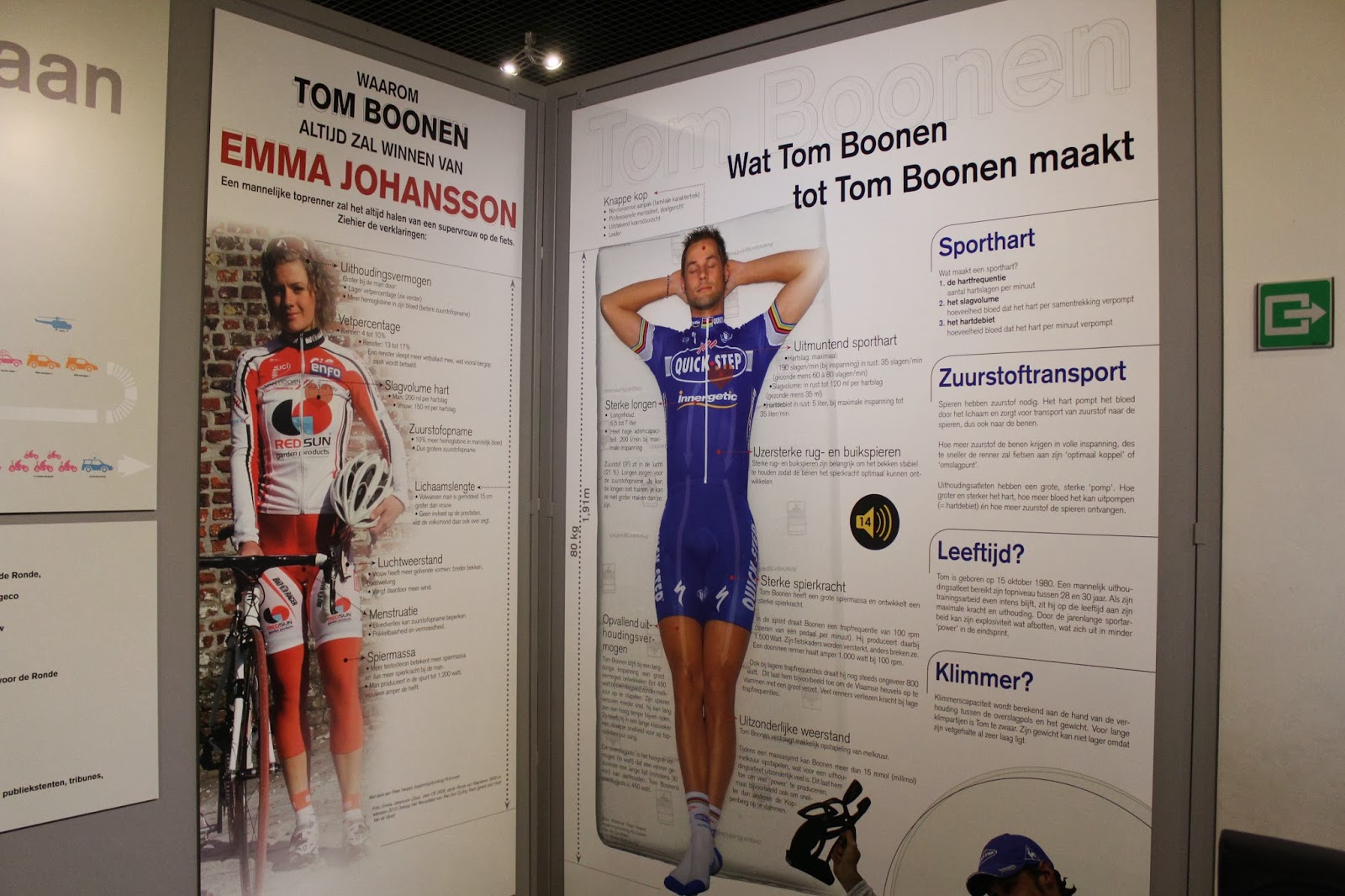
The museum is certainly dedicated to Flemish pride (don't look for French-language labels either) and there are some wonderful exhibits, including one entitled “What is a Flandrian?” and is captioned: “They are carved from the same rock from which statues are sculpted.” Tough is good. Feminists will have a laugh about the exhibit explaining why Tom Boonen is much, much stronger than Emma Johannson. I did not notice any special exhibit dedicated to the Women's Tour of Flanders, which is a shortened version of the men's race and is held the same day.


Enough quibbling: there is plenty of good stuff to see here. There are exhibits of many Holy Objects, such as the bicycle Johan Museeuw rode at the Ronde in 1998 and lots of jerseys and many old bicycles. In addition to Ridley, Flanders has had other notable bicycle brands, such as Groene Leowe (“Green Lion”) but clearly the most-loved was ill-fated Flandria, whose red bicycles were a symbol of Belgian dominance in pro racing. The company was founded in the 1950s and sponsored a pro team in the 1960s and 1970s which went on to win every significant race except the Tour de France (although Dutchman Joop Zootemelk came second twice on a Flandria there. The team roster was a Who's Who of cycling and the collapse of the company in 1981 when its moped business bankrupted Flandria came as a huge shock in the cycling world.


There is a special exhibition area dedicated to Walter Goodefroot, famous to a later generation as the directeur sportif of Team Telekom, but someone who had an impressive record as a pro racer himself. His wins included Liège-Bastogne-Liège three times, the Ronde twice and Paris-Roubaix in 1969. His three disqualifications for doping are not mentioned; in fact, doping does not exist in the happy world that is history in the Centrum van Vlaanderen. It is a Flemish celebration, after all, and there are better fora to discuss this problem.


The museum does celebrate its most recent edition with a display on the 2013 race and Fabian Cancellara, in spite of his sporting rivalry with Flemish demi-god Tom Boonen, was a popular winner and there is even a fan club for him in Belgium.


Exiting the museum brings you to a very good little shop where you can purchase retro-jerseys, books and DVDs, along with some excellent Lion of Flanders memorabilia. And after all this cobblestoned excitement, what better time than to walk over to the always-busy brasserie “de Flandrien” for some excellent Belgian beer brewed especially for the place, which also serves as the clubhouse for a local cycling club.

The Centrum Ronde van Vlaanderen is a commendable effort that brings together local pride, sporting tradition and community activity in one very pro-cycling environment. Located 30 kms south of Ghent and 75 kms west of Brussels it should be on the itinerary of every cycling enthusiast. Just be sure to bring a strong wheelset.

Information about the Centrum van Vlaanderen can be found here.  It is open daily except Monday from 10:00 am to 6:00 pm, but is closed for most of January each year so check ahead. If you would like to ride in Flanders from the Centrum, three routes from 78 to 114 km are set out here.

Tuesday, 23 October 2007

Book Review: Paris-Roubaix: A Journey Through Hell

This review was written for www.pezcyclingnews.com

Greg Lemond famously said about cycling:” It doesn’t get any easier. You just get faster.” And for a sport that values the ability to suffer, the least easy of all races is Paris-Roubaix, variously feted as “the Queen of the Classics” and cursed as “the Hell of the North.” In 2006, L’Équipe published a gorgeous history of the race and it is this book, in an excellent idiomatic English translation by cycling historian David Herlihy, that has now been published by VeloPress. Compared to the vast tide of books about the Tour de France, this one appears to be the only substantial work in English about Paris-Roubaix, in spite of the race’s legendary status. This in itself merits its inclusion on a cyclist’s bookshelf, but the book has intrinsic qualities that make it a must-have.

Paris-Roubaix is a throwback to another age. When it began in 1896, the velodrome ruled the land and road races were the exception: difficult to organize and with only a few racers, unable to compete for the rich prizes of the tracks, available to participate. To enliven proceedings, some velodrome owners promoted road races to end at their tracks. This was the case of Paris-Roubaix, and at the first race was so novel and popular that part of the grandstand collapsed under the weight of spectators. The winner, the German strongman Josef Fischer, completed the race at an average of over 30 km/h. So this race had everything: an international field, a challenging route and an exciting sprint finish. It has gone from strength to strength as the other classics from that year (Paris-Mons? Paris-Royan? Bordeaux-Paris?) are long gone, along with most of the velodromes. This book covers the race from its beginnings, a time when cobblestones were commonplace and men and bikes seemed to have been made of iron, to today’s carbon-fiber age but the race has always been brutally hard, a merciless test of men and equipment.

The authors have approached the race in a clever and unusual fashion. Rather than following a chronology, the majority of the eleven chapters of Paris-Roubaix: A Journey Through Hell are divided into different aspects of the race These include: the cobblestones themselves; the impact of the weather; messed-up finishes; unexpected winners; the Roubaix velodrome; and a brilliant chapter devoted to the effects of getting a flat tire. There is a gallery of the most celebrated winners and the whole book is stuffed with marvellous photos taken from the archives of L’Équipe. There appear to have been photographers present at every dramatic crash, or else there are always so many crashes that you just have to stand around and wait.

The race has attracted cycling’s greatest figures, who seem to have always had a love-hate relationship. Bernard Hinault felt that Paris-Roubaix was a ridiculous race, a lottery where chance ruled but he knew that posterity demanded that he win Paris-Roubaix. He did it in convincing fashion in 1981, wearing the rainbow jersey of the World Champion, and crushing five opponents (four of them previous P-R winners!) in the final sprint at the velodrome. Although the race counts several other Tour de France victors among its winners, including Garin, Lapize Coppi and Merckx, it is more notable for its special “hard men,” who have specialized in beating the cobbles, such as four-time winner Roger de Vlaeminck, three-time champion Francesco Moser and the indomitable Gilbert Duclos-Lassalle, who participated in the race seventeen times, finally winning on the 14th attempt and repeating the following year. Their stories are all told in loving detail in this book.

Details indeed. For example, there is a section recounting how Jean Stablinski, a former World Champion, suggested a particular section of cobbles to the race organizers and the famous Wallers-Arenberg stretch, a positively medieval piece of road, was added in 1968. The modernization of France meant the removal or paving over the cobbles that are such a characteristic (and feared) part of the race and by 1968 the race against time was on as the countryside was scoured to find more cobbled roads. At its lowest point in 1965, the Queen of the North had only some 22 kms of cobblestones in its 294 km route. Today efforts have been made to protect and preserve the famous roads and the pros can look forward to more than 50 kms of pavé in twenty-six sections. And the mud and the dust are with us always.

And the people who protect and preserve the roads are the subject of the last chapter, “The Angels of Hell.” Described as the “guardians of the temple,” these include journalists, fans and even the artist, who painted 12 kilometers of cobbles (using 18 tons of paint) as a work of art and a tribute in 1986. This is the kind of insight so lovingly presented in Paris-Roubaix: A Journey through Hell. There is no reference to the amateur version of the ride, held in September rather than in the third week of April as is the pro race, but the Everyman participants in that ride are given a piece of pavé when they reach the velodrome in Roubaix as a memento, echoing pro cycling’s most cherished trophy, the single cobblestone mounted on a plaque, that goes to Cycling’s Strongest Man every Spring. A beautiful book about a beautiful race.

(note: all photos courtesy of VeloPress)

Paris-Roubaix: A Journey Through Hell
by Philippe Bouvet, Pierre Callewaert, Jean-Luc Gatellier and Serge Laget
trans. by David Herlihy
VeloPress, 2007hardcover, 224 pp., $39.95

ISBN-13: 978-1-934030-09-7